
Kishōtenketsu for Writer-Directors: Why Demon Slayer's Infinity Castle Works
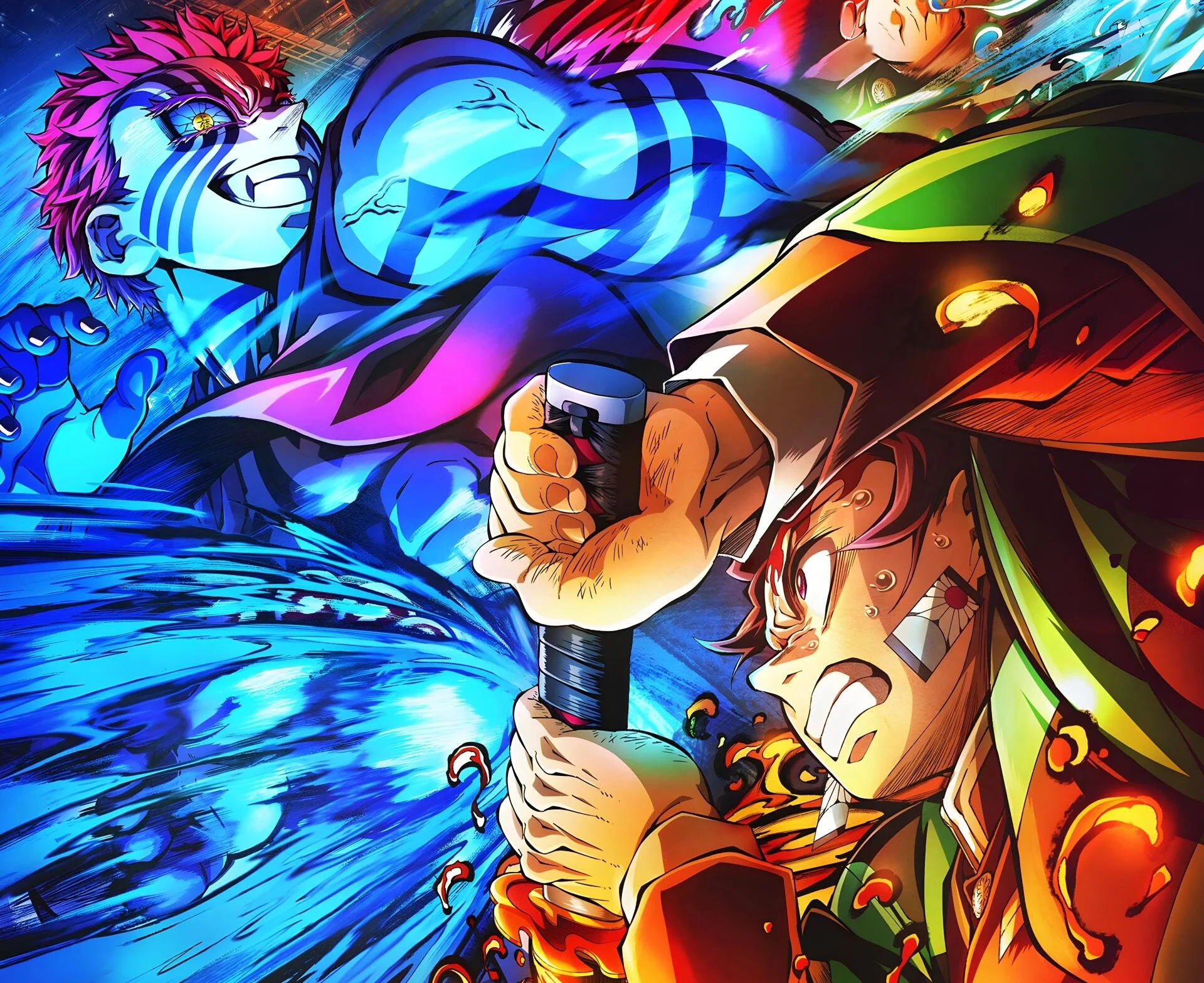
Demon Slayer’s Four-Act Structure: A Screenwriter-Director’s Guide to Kishōtenketsu
Demon Slayer: Infinity Castle feels "off" to some viewers because it uses kishōtenketsu, a four-act East Asian structure built on contrast and perspective shifts rather than relentless conflict. For writer-directors, that means your "slow" scenes may be doing structural work that Western readers don't recognize.
In this article and video, I break down how kishōtenketsu works, what the kanji reveal about it, and how Demon Slayer blends it with Western conflict in the Akaza fight. Watch the video below, or skip to the section you need.
Video explaining how Japanese kishoutenketsu story structure works using Demon Slayer: Infinity Castle
Key takeaways:
Kishōtenketsu has four parts: ki (rise), shō (receive), ten (turn), and ketsu (tie together).
The storytelling engine is contrast, not conflict.
Demon Slayer is a hybrid: a Western-style conflict plot contained inside a kishōtenketsu emotional structure.
The flashbacks that interrupt the Akaza fight are a structural choice, not a flaw.
Writer-directors can use this to protect and elevate "slow" scenes that are doing real work.
Why does Infinity Castle feel both brilliant and broken?
The thing that makes Demon Slayer: Infinity Castle feel wrong to some people is the exact thing that makes it a masterpiece.
Some viewers say it's a masterpiece of tension—relentless, gripping, perfect. Critics say it's a pacing disaster—flashbacks everywhere, ruining what should've been a clean action film.
Here's the strange part: they're describing the same movie. So how can a film be brilliant and broken at the same time?
The answer is a four-act storytelling structure you've probably never heard of — and it's the reason this film feels the way it does.
If your screenplay has ever been called 'slow' or 'meandering' by a reader, pay attention. Demon Slayer does the exact thing readers and gurus tell you never to do — and it's the highest-grossing anime film in history. So either the readers are wrong, or you've been taught structure wrong…or both?
And yes, spoilers if you ain't seen it. Still, I recommend every writer and director to rewatch the film and see if you can spot the unique storytelling structure I'm about to break down.
Is the pacing a manga problem or a structure problem?
If you look up reviews online, you'll find people asking some variation of the question, "Why is Infinity Castle paced so differently from a normal action movie?"
And part of that is due, of course, to the source material.
Kimetsu No Yaiba 鬼滅の刃 — which is Demon Slayer's original Japanese name — was originally a serialized manga where chapters debuted weekly before being adapted into larger volumes. And, if you're familiar with the story, you likely have seen the anime show before watching the more recent stand-alone theatrical films like Infinity Castle or Mugen Train.
So that's why some people say "Infinity Castle feels jarring because they just jammed several episodes into one movie." I don't think that's totally fair to the adaptation of the source material, but I get what they mean.
Still, the talk about Infinity Castle's pacing is less about manga to anime to feature film and more about story structure. So, does Demon Slayer follow the three-act structure?
No, actually, it doesn't.
What is kishōtenketsu?
Kimetsu no Yaiba is written according to kishōtenketsu — an East Asian four-act story structure where the third "act" isn't anchored in conflict but is centered around a turn or twist. That twist is why the pacing feels so unusual.
However…if by twist, you think I mean Hitchcock or Shyamalan plot twist, that ain't what I'm talking about! Keep reading so I can explain the difference.
Kishōtenketsu originates from a type of ancient Chinese literary form, and then spread and grew across East Asian countries; kishōtenketsu (sometimes written as ‘kishoutenketsu’) is the Japanese version and is usually the form Western audiences are more familiar with.
Here's what kishōtenketsu actually is:
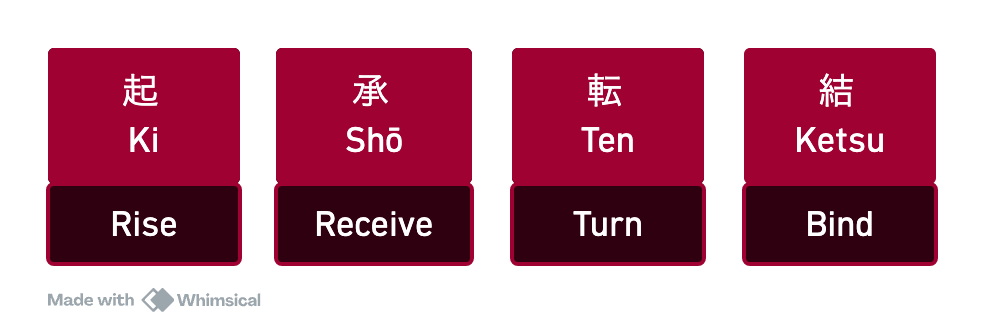
Let’s break it down. This is kishōtenketsu explained:
KI: Rise (situation arises, drawing/forcing character in)
SHOU: Receive (situation unfolds, characters react)
TEN: Reversal (perspective or situational, not driven by conflict)
KETSU: Bind (ties reversal together with original thread, reconciling them)
What do the kanji of kishōtenketsu teach screenwriters and filmmakers?
As someone who's been studying Japanese for years, I've trained in Japanese martial arts, and have actually been to Japan for work, I view this structure differently than the average screenwriter or director.
Carl T. Rogers at Sensō-ji in Tokyo
Because of that, I want to draw your attention to the actual kanji characters of this compound word kishōtenketsu to help you understand what it means and how you can apply it.
起 - Ki
Means rise, begin, or cause
Like "to get up" 起きる;
Contains the radicals 走 ("run", hashiru 走る) + 己 ("self" onore)
承 - SHŌ
Means to receive, continue, acquiesce, hear, listen to, or comply with
Like "I acknowledge" in "承知します" "shouchishimasu"
Contains the radical for "hand" (手 te)
It might sound passive, but the original ideogram that evolved into this kanji showed a kneeling person while holding something up.
Same with shōchishimasu — it's accepting, yes, but it's deliberate agreement, not just submission.
転 - TEN
Means to turn, revolve, shift, change
Radical for "vehicle/wheel" which means "car" in modern Japanese 車 (kuruma)
Same character as "wheel throw/rotary throw" 回転投げ (kaiten nage) in Aikido
Same as the 180˚ turn or pivot in Aikido tai-sabaki and other martial arts called "tenkan" 転換
結 - KETSU
Means to tie, bind, and conclude
Uses the radicals for 糸 ("thread, silk") combined with 吉 which adds a positive connotation of "good luck" or "joy". You combine these to make this ketsu character which is used not only for tying together or fastening, but also for uniting, concluding, and even bearing fruit.
You'll see this in the Japanese word for marriage, kekkon 結婚
What story do the four kanji tell together?
Why am I breaking down all the kanji in kishōtenketsu? Because when you put all this together, and you get a little story in itself:
Rise → Receive/Hold → Turn/Pivot → Tie Together
Notice what's NOT there: Relentless conflict or confrontation.
And if you've studied manga or anime storytelling before, you may have seen kishōtenketsu called "conflict-less storytelling."
However, I don't think that's accurate, especially when we're talking about long-form narrative like an entire series or feature film. There is tension or mystery, but there doesn't have to be lots of "conflict" for the story to work.
To say that kishōtenketsu is a type of story without conflict is a caricature.
Kishōtenketsu may be low-conflict or low-stakes—like a Ghibli movie, but there's usually still a goal or objective (at least in a general sense) that the characters are pursuing, but they may be going about it differently than a Western writer would have them do so.
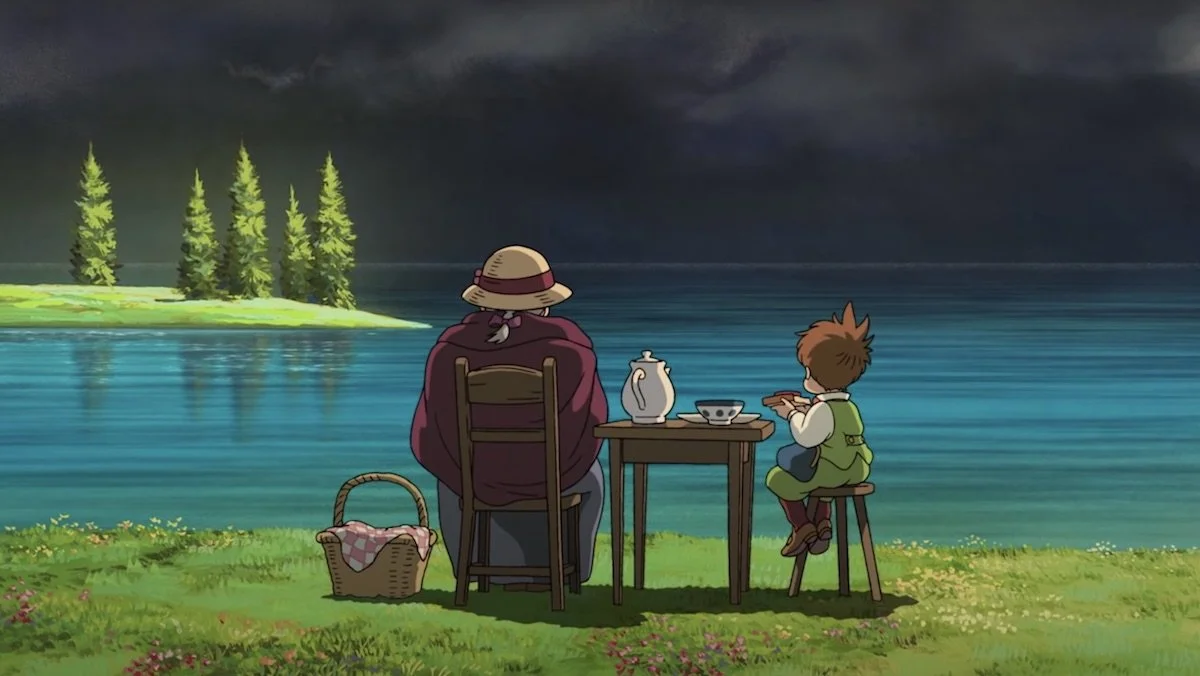
Can you name this Miyazaki movie?
This is because the main engine of kishōtenketsu is contrast, not conflict. The characters and their world are introduced in ki and explored in shō in order to be harmonized in ketsu rather than overcome or defeated. That's why the ten ain't always a huge climactic battle but is rather a shift in perspective.
This pattern is inductive; the audience is forced to reconcile the whole from the parts. Micro to macro. It's more about the why something happened rather than the what happened or who wins.
Shō is intentional, not filler. It's actively building a perspective or normalcy to set up the shift later on. And oftentimes, the ten is for the audience or other characters to experience, not necessarily just the protagonist.
This is similar to the character's "epiphany" or "self revelations" in a 3 Act story, except it is the emotional engine rather than merely being a plot point mechanism.
Is the ten the same as a Shyamalan plot twist?
Here's another area that's easy to misunderstand — the "twist" in the ten part of the kishōtenketsu doesn't have to be a jarring or unexpected plot twist like in a Shyamalan movie.
Western plot twists usually operate on surprise or subversion of expectations — but the ten in kishōtenketsu ain't about shock value. In a movie like that, the audience learns a hidden truth that rewrites everything they thought they knew.
In kishōtenketsu, the ten, or the turn is the door, not its hinge.
It's about a change in understanding through comparison, or juxtaposition, or point of view—hence the importance of the kanji's relationship to a wheel turning. Are your wheels turning?
So, that's how the kanji's etymology helps you understand the mindset behind this story structure.
How is kishōtenketsu different from three-act structure?
Even with all that said, it can still seem like these are only surface level differences to 3 Act story structures.
Now, some writers—myself included—like to break 3 Act structure into 4 acts (see below), but it's still qualitatively distinct from kishōtenketsu. Any good story still has the general escalation of tension and release, Eastern or Western.
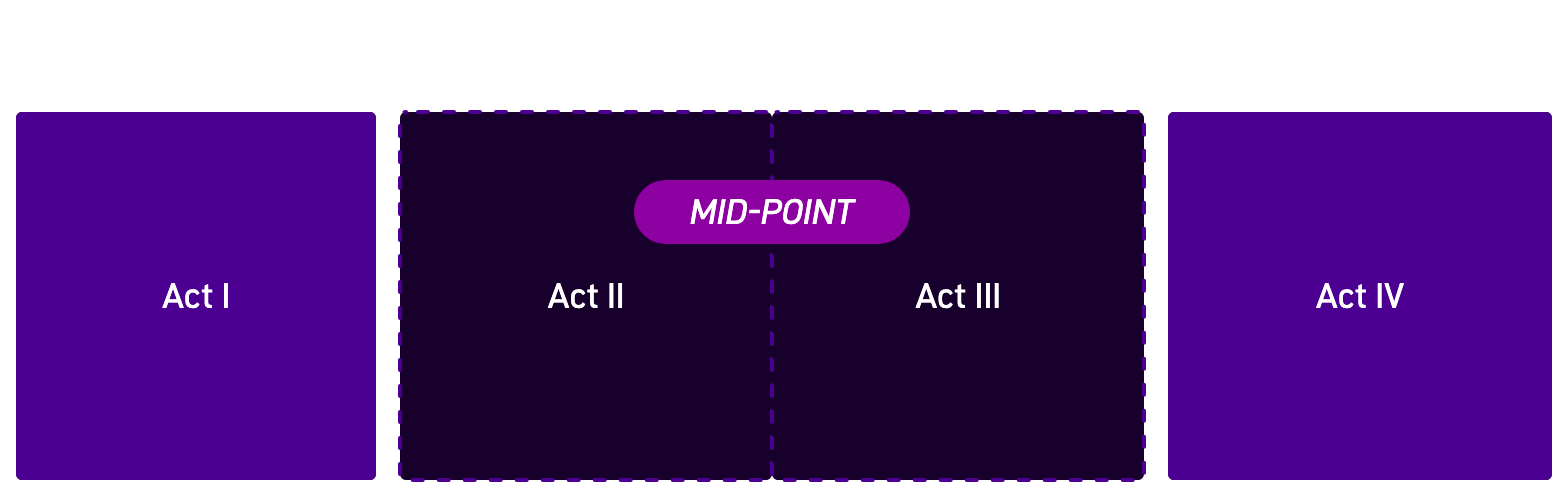
Why is kishōtenketsu so different from Western three-act structure?
The real difference between Western 3 act story structure and East Asian kishoutenketsu is not how you chop up the segments of the story. It comes down to worldview.
I've seen kishōtenketsu called "karmic" storytelling, and Western 3-act called "dharmic."
The Common but Incorrect Comparison:
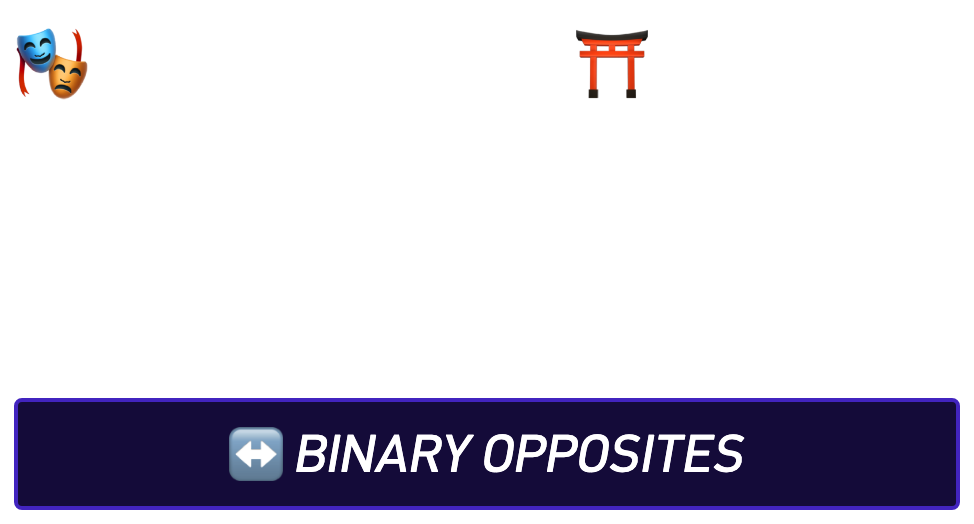
This is how it’s often framed, but it’s WRONG.
They frame it like this: in Western 3-act, characters have a path to follow—that's supposedly dharma. In kishōtenketsu, things just happen to a reactive character — it was the "invisible hand of karma!"
See? East vs West.
Karma vs dharma.
So simple.
So easy to remember.
This is flat-out wrong.
It mashes up a bunch of different Asian religions into a punchline. And it uses "karma" the way English uses it colloquially over coffee: fate, luck, or poetic justice.
That's not what the word meant.
Karma, as it's originally understood, doesn't imply passivity. The opposite, in fact. Indian Hindu karma and Japanese Buddhist karma aren't the same, but they share this:
Karma is volitional action and its spiritual consequences, in this life or the next.
To call karma passive is like saying a surfer catching a huge wave is just "passively floating." They didn't create the ocean, but it takes immense skill and split-second timing to ride the wave without drowning.
Even the Sanskrit word that the word karma comes from meant "to act." Actual karmaic law is serious, and requires effort, not passivity.
Dharma isn't the opposite of karma, either!
In Hindu thought, dharma refers to a set of moral laws that everyone is supposed to follow.
In Buddhism, it's about universal truth as set down by the Buddha.
So in either of these religions, karma and dharma are part of an interlocking system, not binary opposites. Using these to define 3 Act structure or kishōtenketsu is sloppy at best.
Okay, philosophy sidebar complete. Feel smarter?
How does worldview shape kishōtenketsu storytelling?
What I said is still true, though. Worldview deeply affects how a writer tells a story, and that's clear with kishōtenketsu. There are multiple fundamentally East Asian philosophical perspectives embedded in these stories because any writer will imbue their beliefs into what they write, and the culture they belong to, namely: Buddhism, Shintoism, Confucianism, and Taoism.
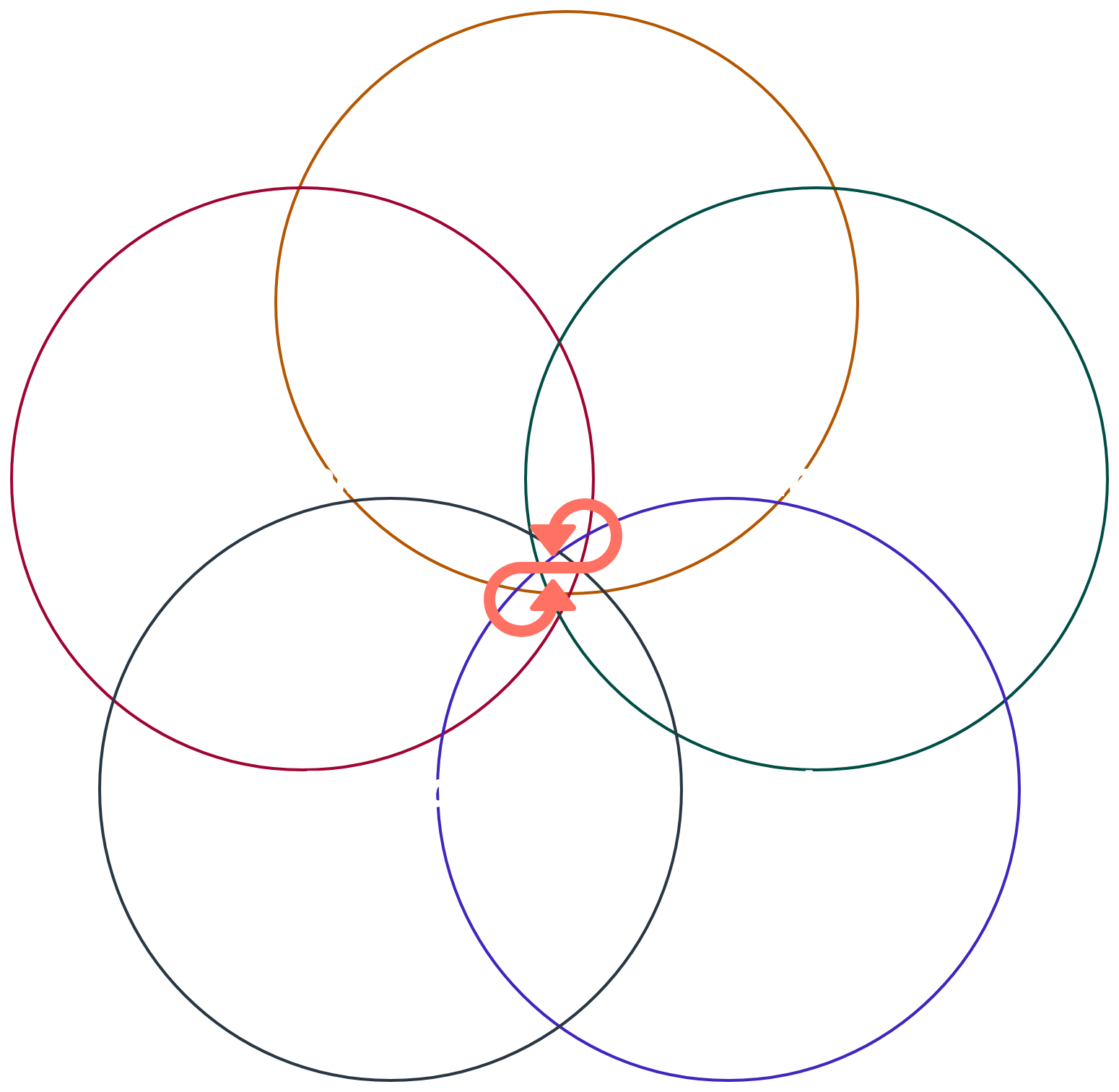
I can't cover all of it here, but to name a few of the worldview influences:
Buddhism is all about ridding yourself of selfish desire and selfish delusions of reality, so honorable characters are sometimes meant to be reactive or responsive. Buddhism teaches that you must overcome yourself rather than others, so that's the reason characters can seem passive to an outsider.
This is related to the Taoist mindset of wu-wei, or "skillful non-action." Think "character driven" or "internally focused" rather than being merely passive.Buddhism also prizes appreciation of slowness and living in the moment because of its focus on mujō, or the impermanence or transience of all things.
That's why you can have a still scene in a Japanese movie that feels atmospheric—you're missing the point because you didn't know the philosophical posture (until now). Poignance over progression.Shintō and Buddhism also focus on harmony, though in different ways. Because the two have blended over the centuries in Japanese culture, the two have blended into a unified whole (Shinbutsu-Shūgō).
Japanese philosophy views the world as interconnected, cyclical, and fluid. Characters are meant to realize this as part of their arc, and that's why things get tied together (at least emotionally, if not plot-wise) in the ketsu part of the structure.
These philosophies — these cultural mindsets — become the air the writers and filmmakers breathe without even realizing it. Their worldview changes how their stories depict agency, change, truth, purpose, and redemption. How is your worldview changing how you write—and how you live?
How does Demon Slayer use kishōtenketsu?
Let's tie it all this together. (See what I did there?)
You might have been nodding with me, understanding how an Ozu or Miyazaki film, with its deliberate slow pace and lack of much fighting, fits with this Eastern worldview of balance, harmony, and inward contemplation. But what about Kimetsu no Yaiba 鬼滅の刃?
If kishōtenketsu isn't based on conflict, why is Demon Slayer all about fighting?
Kimetsu no yaiba is actually using a hybrid story structure — it combines the best of Eastern and Western storytelling techniques, and I think that's one of the reasons behind its popularity across cultures.
Kimetsu no yaiba literally means "blade of demon destruction." It's a story all about finding and annihilating powerful demons with special katana and breathing techniques. There's multiple factions in the world battling for control with different goals and motivations. Of course there's conflict!
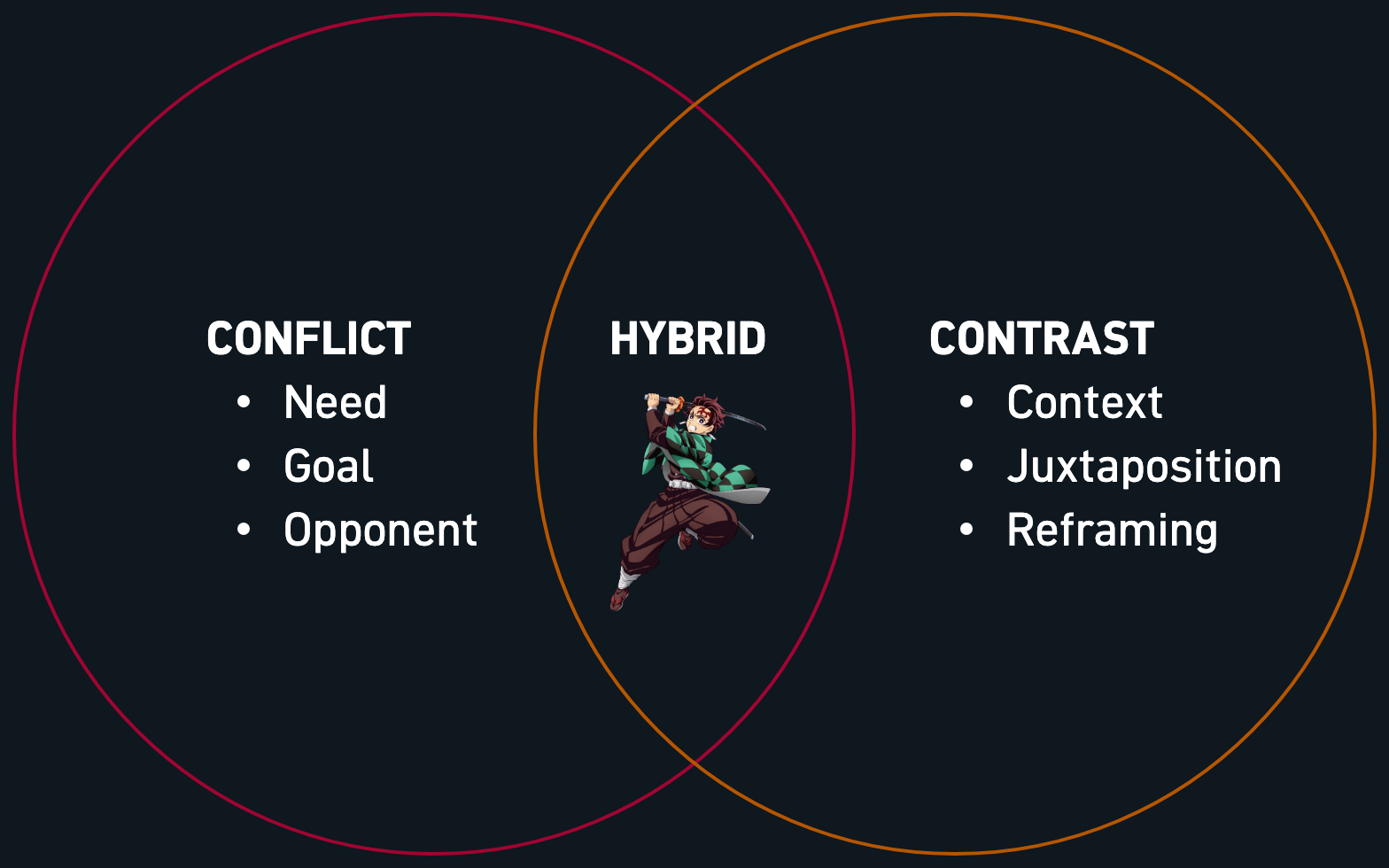
Demon Slayer borrows from both Western and Eastern storytelling traditions.
BUT…not every scene, beat, or emotional payoff is grounded in that conflict. The conflict enables the contrast, but they're still distinct.
Tanjiro and Giyu vs. Akaza: a kishōtenketsu breakdown
I'll show you what I mean: Let's look at the coolest and most memorable fight in this film: when Tanjiro and Giyu fight the upper rank demon Akaza.
Ki (rise)
The earlier half of the film is the Ki. The cliffhanger from the previous season sets up the team trapped in the infinity castle, and so the opening of the film shows all the players: some you get to see fight in this film, and others are just briefly shown so you don't forget about them for the future films in this trilogy.
We get the fight between Kocho and Doma, and the showdown between Zenitsu and Kaigaku, showing how hard it is to fight the ranked demons with no means of escape.
Then, we build up to the most important fight: Tanjiro and Giyu encounter Akaza, whom Tanjiro previously encountered in the Mugen Train film and begin their battle. Tanjiro wants revenge for killing Rengoku, who he really looked up to.
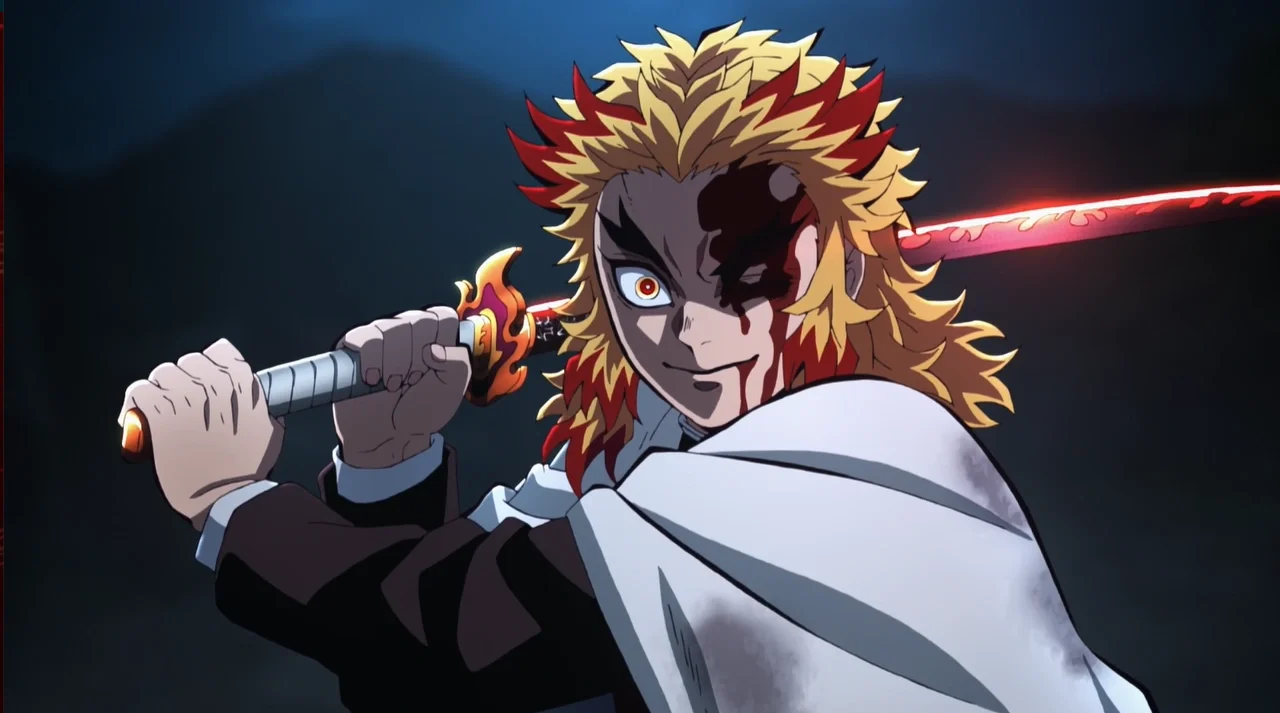
Shō (receive)
Events develop more emotional weight as they unfold. Akaza says he hates the weak more than anything, but Tanjiro says, "You may not remember it, but when you were a baby, you were protected and helped by someone, and that's why you're alive now."
This shows their difference in values and foreshadows Akaza's backstory revelation.
Akaza's first flashback right after that is of his sensei saying, "The opponent you're up against will always be yourself." (Sound familiar?)
Tanjiro also remembers a conversation with Inosuke about sensing the intent to kill, and a deep memory from his childhood — his father's Transparent World technique.
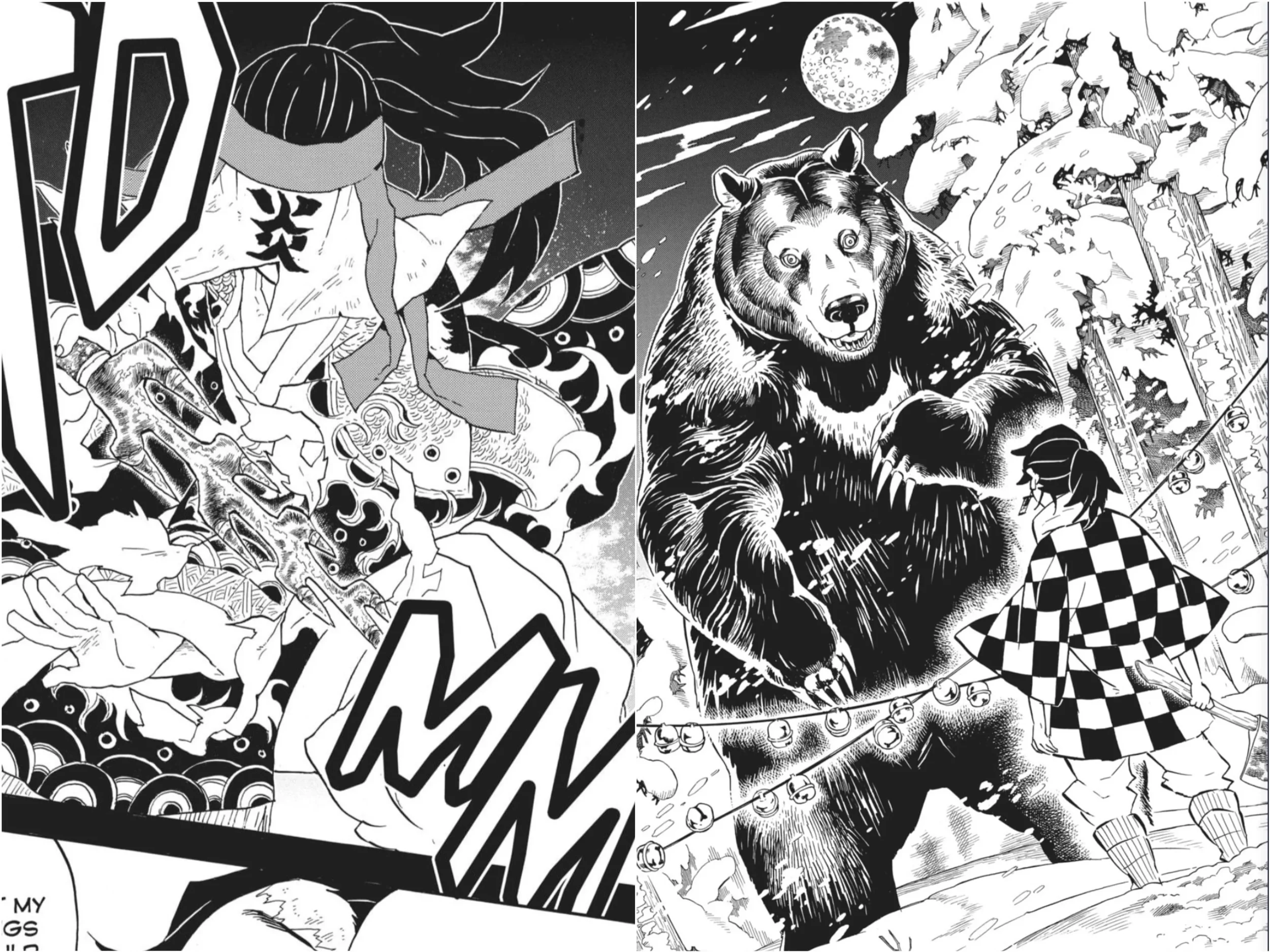
And as they continue to fight, and the conflict and excitement grows, Tanjiro is able to use this technique to finally behead Akaza!
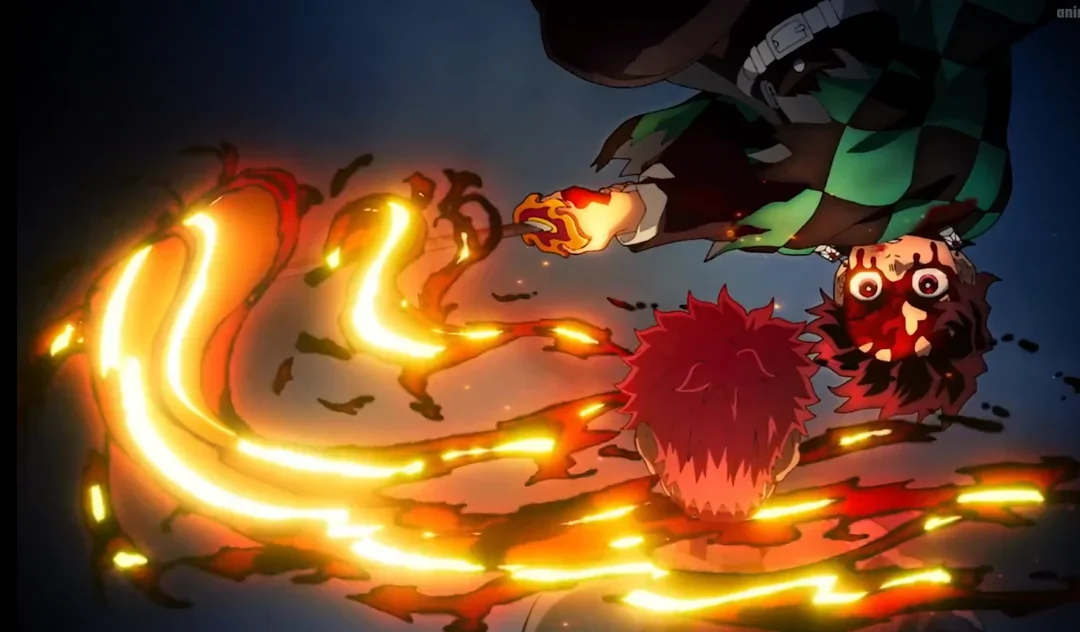
Ten (turn)
But… Akaza doesn't die. Any normal demon would turn to ash as soon as their head was cut off… but not Akaza. That's the external, plot ten.
His head vanishes, but his demonic body continues fighting, and nothing Tanjiro or Giyu do can stop him.
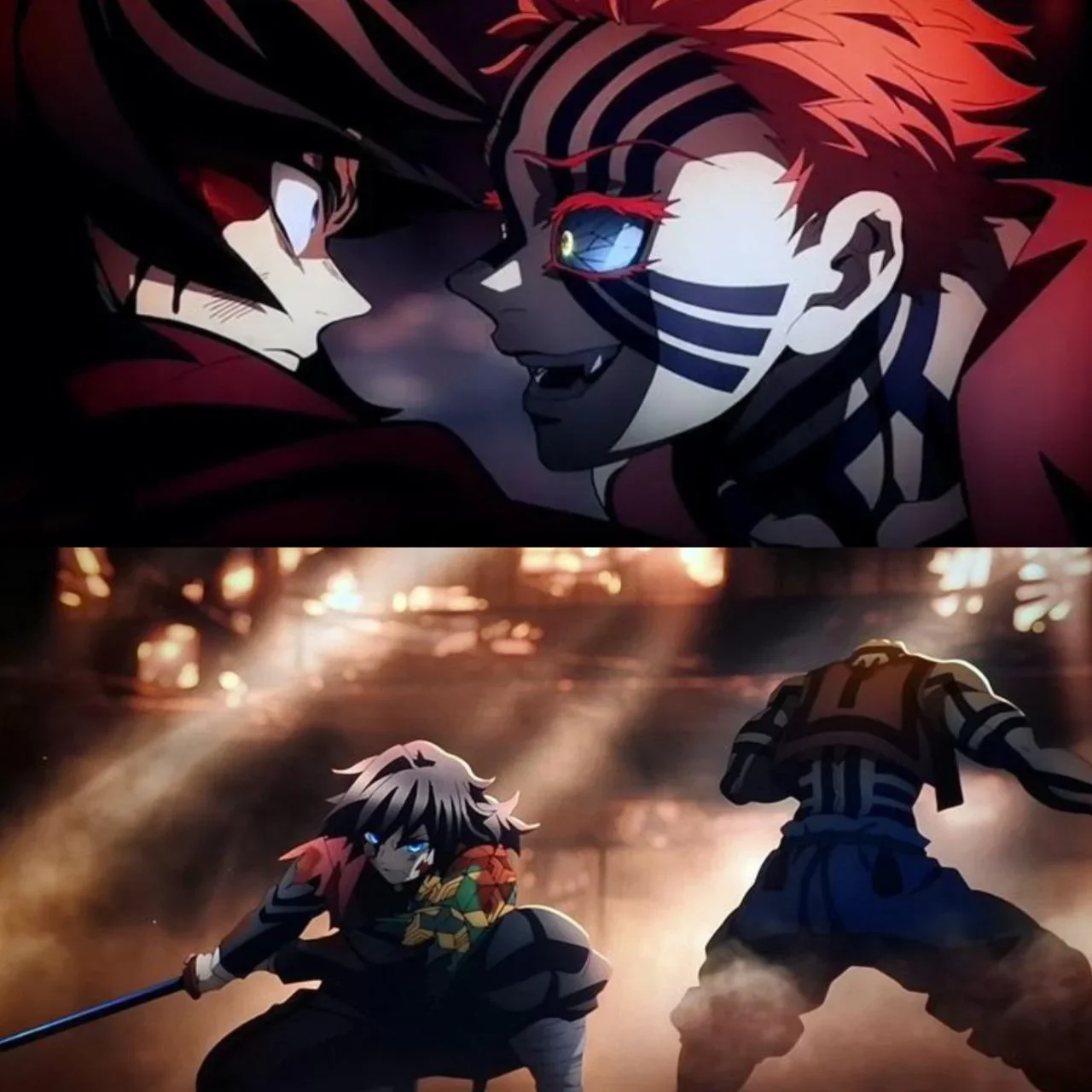
Until… Akaza flashes back again.
The fighting stops (to the audience) as we learn Akaza's origins as a thief with a sick father, how he was humbled by a martial artist who became his mentor, and then how he cared for and fell in love with the sensei's daughter.
When she asked him to marry her, he said he's become stronger than anyone else to protect her.
When a rival dojo kills his sensei and fiancée while he's away, he goes berserk and kills 67 people. Muzan finds him and turns him into a demon.
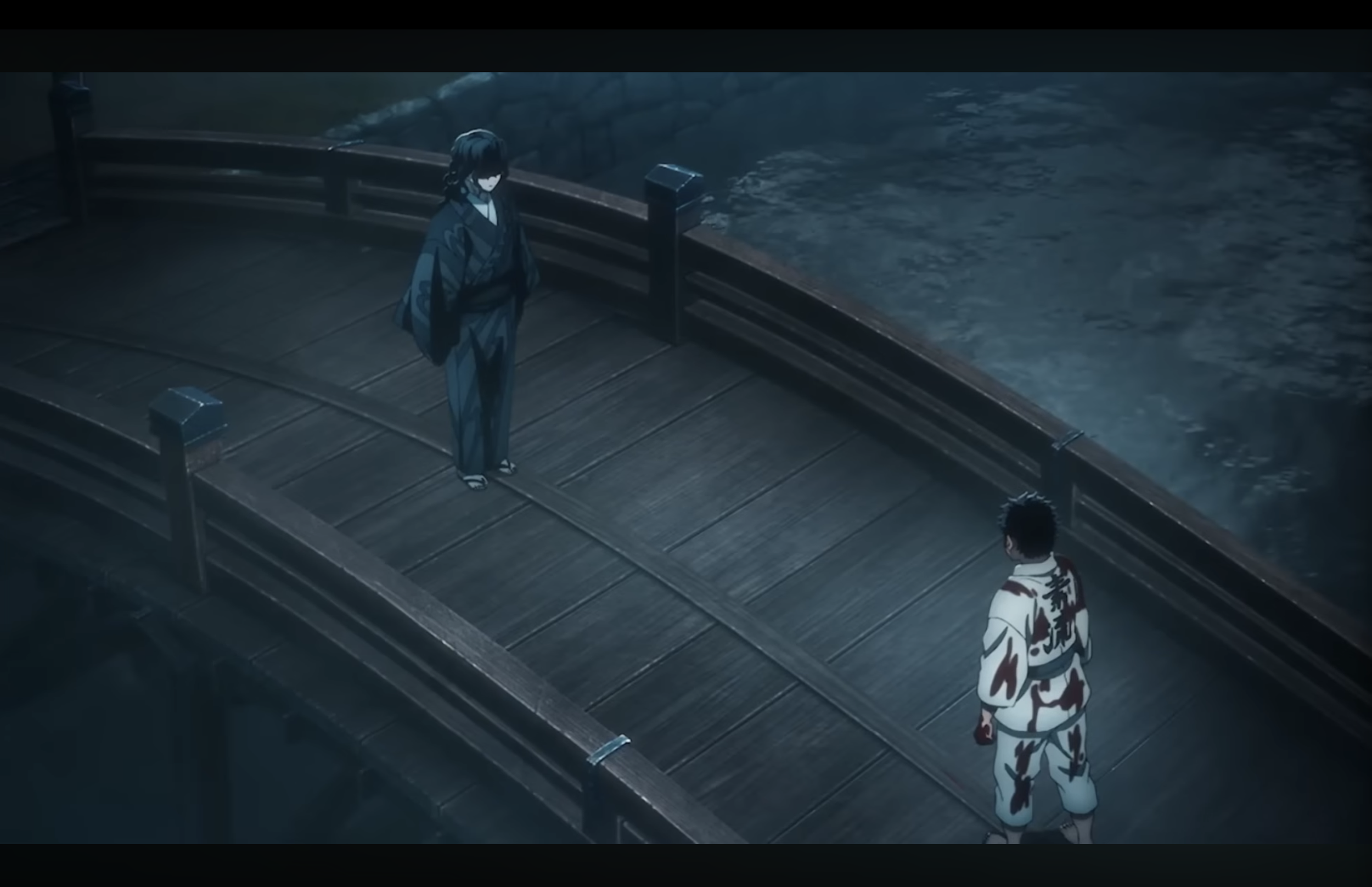
Even as he regains his memory, Akaza laments his past but still fights on—it's only when a desperate Tanjiro punches him in the face does he realize the weakling he needs to kill is himself. He destroys himself, and repents to his loved ones before going to hell. That's the internal, psychological ten.
Ketsu (tie together)
So, what Tanjiro learned — removing his killing intent, almost like removing his desire for revenge — enabled him to dispense justice to Akaza.
Conversely, Akaza — or rather, Hakuji, as he was known as a human — remembers his own weakness and regains his humanity, ultimately choosing to destroy himself.
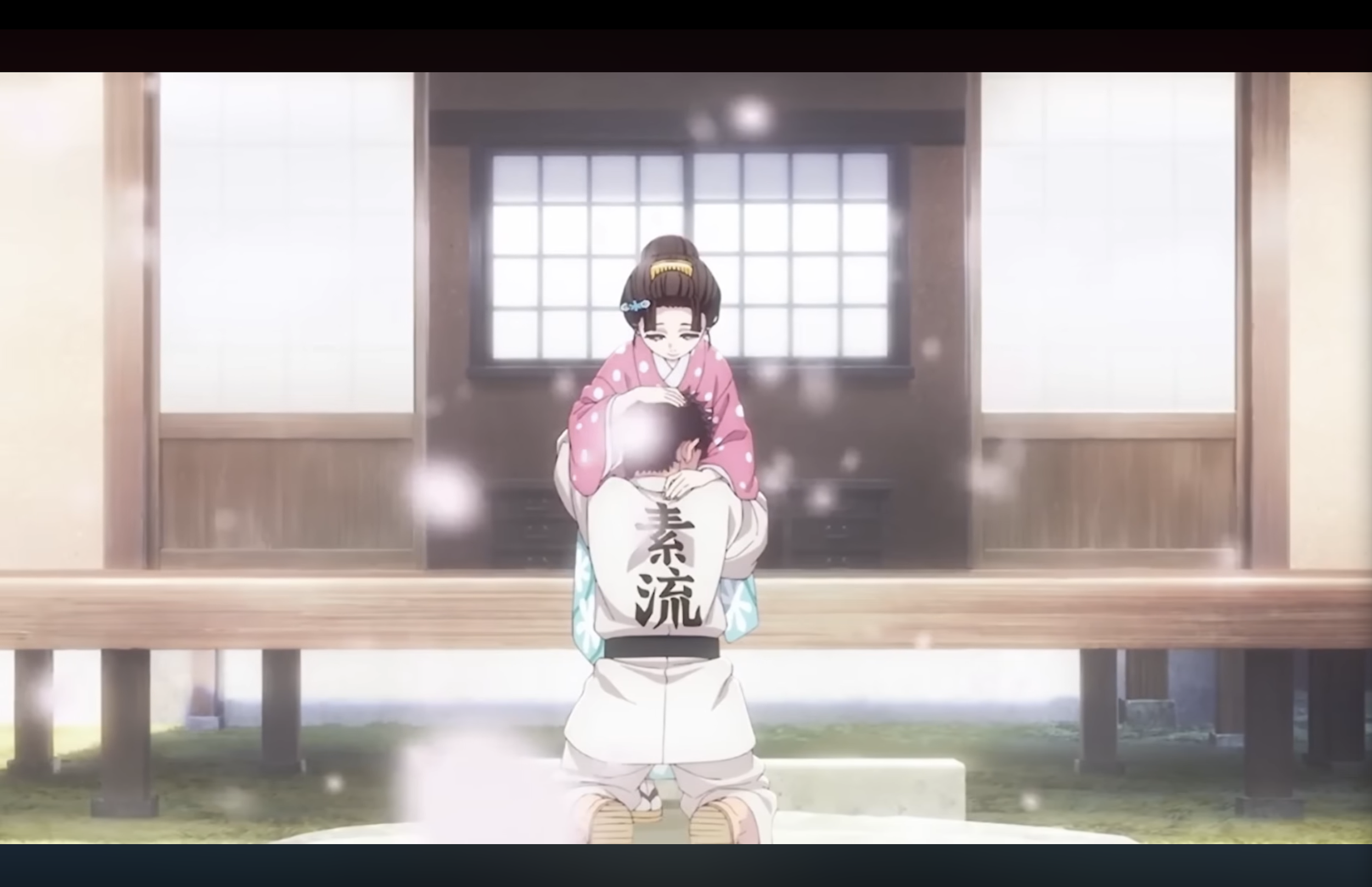
He finally defeats his worst enemy: himself. Very Buddhist.
But…it makes me wonder… if seeing himself clearly "kills" Akaza, what would it take for the truth to save someone instead of ending them?
Thematically, this ties Tanjiro and Akaza's arcs together because of their why, not just their how. Tanjiro fights to protect those weaker than himself, and when akaza remembers his vow to do the same, he destroys himself to protect Tanjiro.
That's true ketsu.
Then the final minutes of the film (the larger ketsu) help wrap up the plot elements and set up the next installment of Demon Slayer.
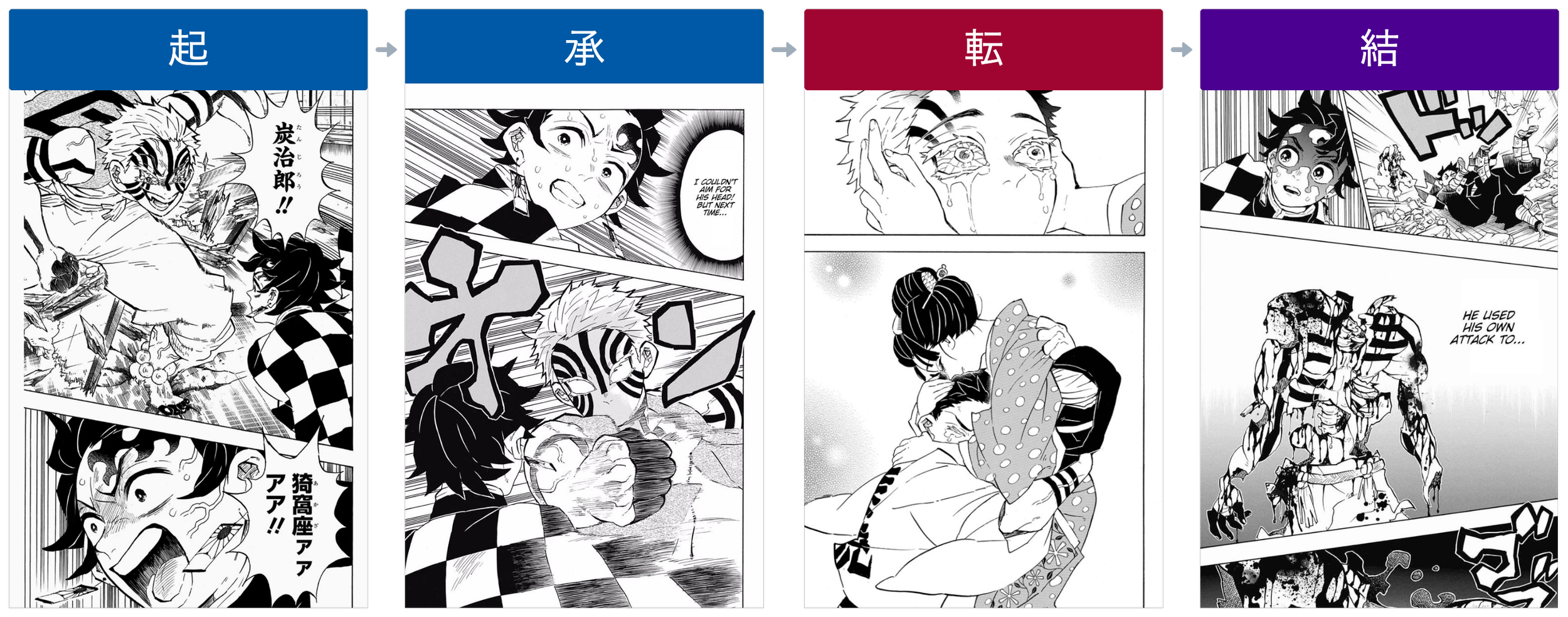
Four “act” manga panel of Demon Slayer: Infinity Castle
Why do the flashbacks interrupt the fight scenes?
So, why do the flashbacks interrupt the fight scenes? That was the #1 complaint across reviews. Now you know: this is as a structural choice, not a flaw. The flashback enables the character's perspective to change and his arc to be completed; the combat is the backdrop rather than the engine.
That's just one example of kishōtenketsu in action in Demon Slayer — and the cycle of rise, receive, turn, and tie together continues throughout the conflict-driven plot arcs. You could even call kishōtenketsu fractal because of how it repeats on micro and macro layers.
For Kimetsu no Yaiba, Tanjiro's goal of saving his sister and eliminating Muzan provides the external plot structure for the metanarrative, and kishōtenketsu provides the emotional structure to contain that plot. That's why it's plausible to call it a "hybrid" of the two types of narrative mindsets.
Why did critics and fans react so differently?
Audiences across the globe react differently to this structure, too. Audiences and critics unfamiliar with this shōnen-style pacing view Infinity Castle as a stand-alone, 3-act film and expect it to be structured like one. They expected Akaza's beheading to end the fight. When it didn't, they were puzzled that there was still another forty minutes of runtime instead of ten. The experience didn't match their mental model for how a film should feel.
However, the real target audience — fans of the existing IP (intellectual property) — loved it! The filmmakers knew who they were creating their experience for, and they focused on them, not on getting critical acclaim. And because of that, Demon Slayer: Infinity Castle is the highest-grossing Japanese anime feature film of all time.
Does kishōtenketsu appear outside East Asia?
You can find this type of structure outside East Asia. Think to the Ancient Near East (AKA the Middle East) and the famous story of Joseph in Genesis 37-50.
Or think 1st century Judaea and the “Road to Emmaus” narrative in Luke 24: two disciples walk with a stranger, and only at the breaking of bread do they realize who's been with them the whole time.
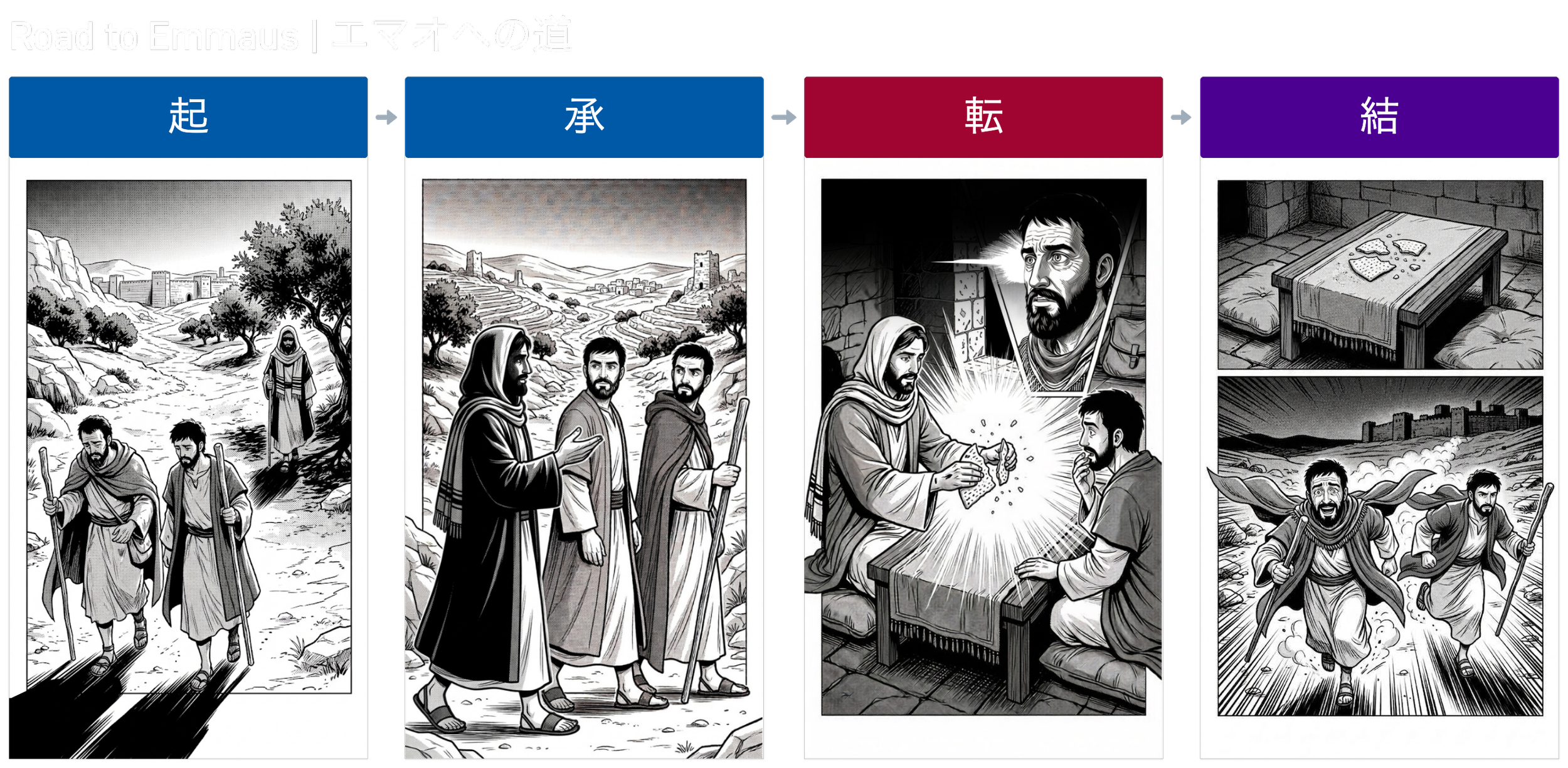
In that story, the ten is for the people in the account more than the reader. The reveal of the stranger as the risen Messiah they've been debating is the ultimate reversal.
I love it because it does in one chapter what kishōtenketsu does in a film: one radical event recontextualizes everything before and after.
If a story can pivot in an instant like that, could history?
Could God, after entering his own plot as a human, raise Jesus from the dead as the ultimate ten no one saw coming?
That’s kishoutenketsu outside of East Asia in ancient Middle Eastern literature and first century Jewish biography. Where else is this structure waiting for you to find it?
What this means for writer-directors
Test your "slow" scenes by asking what contrast they set up. If a shō scene builds a perspective that the ten will flip, it’s got potentially to be true structure and not just filler.
Ask who the ten is for: the protagonist, another character, or the audience — or more than one of the above!
Decide your audience's mental model before you write. Infinity Castle worked for its target audience of anime fans and confused some viewers who expected three acts. Know which one your reader or viewer is.
On the page, a flashback that interrupts action should change the character's (or audience’s) perspective. If it only delivers backstory that doesn’t progress the story, consider cutting it or moving it.
Also think how you can bring these revelations to life on camera. One technique to consider for a huge “ten” moment is to jump the 180º line. Jarring, but intentionally so. When done properly, this can intensify the feeling of contrast or surprise your character is feeling!
Frequently asked questions
Does Demon Slayer use three-act structure?
Not primarily. Kimetsu no Yaiba is written using kishōtenketsu, a four-act structure, and combines it with a conflict-driven plot, so it works as a hybrid of Eastern and Western storytelling.
What is kishōtenketsu in screenwriting?
It's a four-part structure: ki (rise), shō (receive), ten (turn), and ketsu (tie together). Its engine is contrast rather than conflict, and the turn is usually a shift in perspective rather than a surprise plot twist.
Is kishōtenketsu a story without conflict?
No. Conflict can be present, but it isn't the structural engine. Contrast is.
Why do the flashbacks interrupt the Akaza fight?
They are the ten. The flashback changes Akaza's perspective and completes his arc, while the combat serves as the backdrop.
How do I use kishotenketsu in a feature?
Remember that kishōtenketsu doesn’t have to be used for the entire meta structure of your film; you can use this four-part structure for scenes, too.
For example, if you’re having trouble structuring a scene, find the emotional or contrast-driven “turn” that advances the story, and build the rest of the scene around that using the four “acts” of kishoutenketsu. You may find that this works better than a typical “three act” scene structure depending on the manner of emotional stakes at play.
I’m especially thinking of a scene or sequence that hinges on a character realizing something pivotal and its consequences, rather than simply taking the next action. Reflective scenes can feel like they lack momentum, but by using a story structure that relies on contrast and revelation, you can give your emotional moments a scaffolding that fits them more naturally and drives the story forward.
Next steps
And yes, in case you hadn't noticed, I structured my whole video (above) that this article is based on using kishoutenketsu. Rewatch the video if you don't believe me.
If you want me to break down other famous movies that use this structure, let me know in the comments on the video.
Now, if you want to see what happens when a story's structure genuinely does contradict itself — with no kishōtenketsu to save it — I break down The Rings of Power's narrative collapse in this video:
Sources about Demon Slayer & Kishōtenketsu include:
Significance of Asian Kishotenketsu model to filmmaking: A study of Kazakh Cinema by R. Alzhanov, et al.
Beyond the Battle: Historical, Religio-Philosophical, and Literary Depths of Demon Slayer: Mugen Train by R. Green.
Teaching Cultural, Historical, and Religious Landscapes with the Anime Demon Slayer by R. Green, S. Bergeron
Demon Slayer: Infinity Castle taught me not every anime can become a movie
Demon Slayer: Pop Religion and Japanese Anime by B. Winkelman
Exploring the Impact of Flashbacks in Storytelling: A Look at Demon Slayer
Kishōtenketsu and its potential applications to prose writing by G. Oh
Christian Parallels in Demon Slayer by G. Lofton, Jr.
I’m Sorry Demon Slayer, I Was Unfamiliar with Your Game by A. Banks
Japanese Philosophy by Stanford Encyclopedia of Philosophy
Ethics in Indian Buddhism by Stanford Encyclopedia of Philosophy
Kishotenketsu Explained by ComiKen
Kishōtenketsu Story Structure: What It Is, How It Works, and How It Compares to Western Plotting by Oliver Fox
Kishōtenketsu, The Four-Act Structure by L. Salerno
Kishotenketsu: East Asia's Formulaic Secret To Unique Stories by Cloud Kitten Chronicles
Kishōtenketsu: Its a Four-Act Structure With an Incredible Twist by Y. Rhouati
My Guide to Four-Act Story Structure by J. Fechter
Is conflict necessary?: Kishōtenketsu and the conflict-less plot by J. Kindree
Kishotenketsu: The BEST Story Structure EVERY Pro Manga Artist Uses In JAPAN by Monitor Comics
The Demon Slayer Series is Biblical?! by Impact Video Ministries
Shinbutsu-shūgō - Wikipedia
Kishotenketsu - Wikipedia
Kishōtenketsu - TV Tropes
Hindu Philosophy - Internet Encyclopedia of Philosophy
Dharma - Britannica
Karma - Britannica
Kishōtenketsu for Beginners by N. Ödlund
Kishotenketsu by Novelium
Kishōtenketsu by Storytelling DB
Wiktionary (for kanji characters)
Tangorin Japanese Dictionary
Jitenon - Japanese Kanji Dictionary


3 Reasons why Fantastic Beasts 3 was disappointing, and how you can avoid similar story issues in your own screenplays.